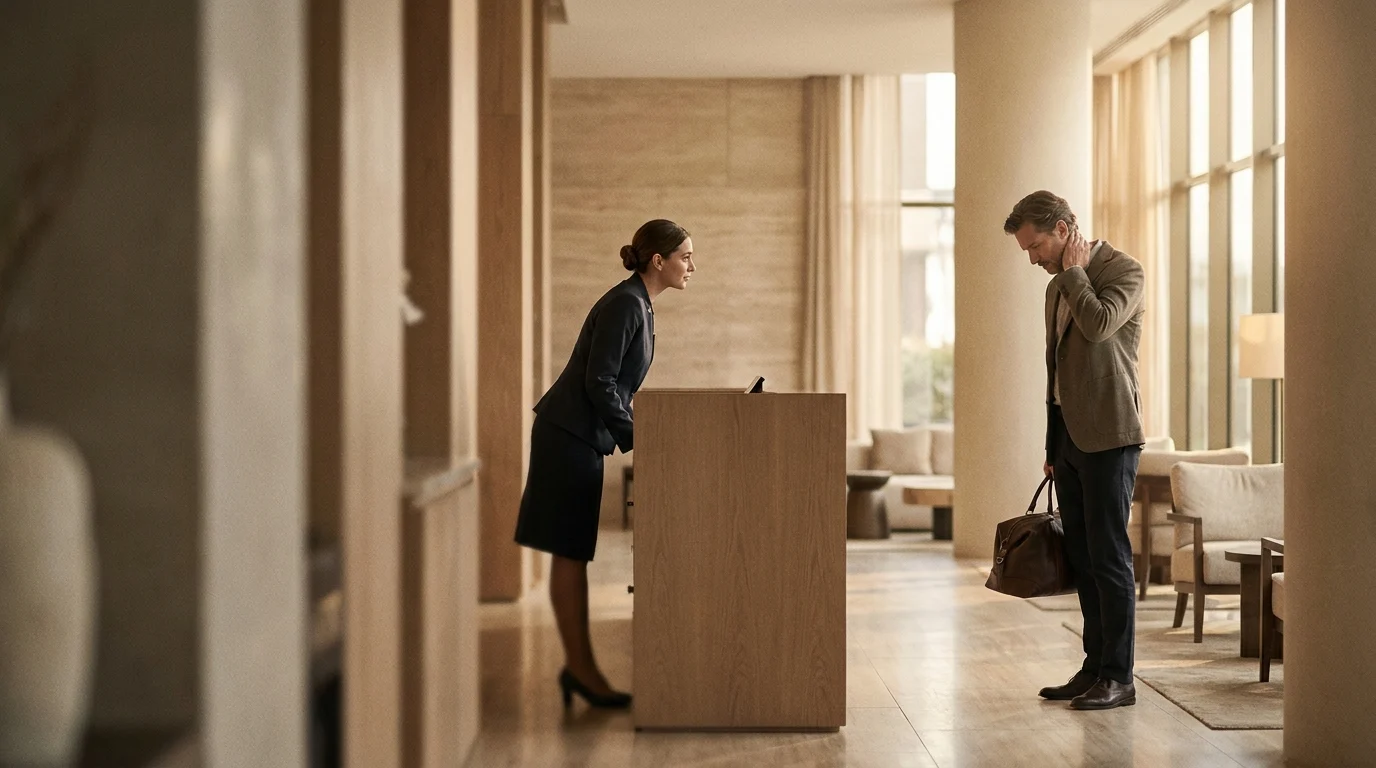
Prevent guest dissatisfaction before it becomes a complaint, withdrawal or lost loyalty.
The Prevention Lab is live, on site behavioural training for luxury hotel and cruise teams. Your people practise how to notice when an experience starts to slip, connect small frictions across the guest journey and intervene without overreacting or making assumptions about the guest.
Live on site. Built around your operation. Measured before and after.
For independent luxury hotels, hotel groups, pre opening resorts and luxury cruise lines.
What is The Prevention Lab?
The Prevention Lab is an on site behavioural training programme for luxury hospitality teams. It helps people recognise early signs that a guest experience may be deteriorating, understand when small frictions are starting to compound, keep useful context alive across departments and intervene proportionately before the situation becomes a complaint, withdrawal or lost loyalty.
Your team stops finding out when the review arrives.
“With this Prevention Lab, we train your teams to catch problems earlier, before the guest has to complain, before frustration builds and before you lose the opportunity to protect the relationship.”Freddie Lovett, Founder of Unspoken Signals
The Quiet No
Catch dissatisfaction the guest never says aloud. Notice change without treating quietness as proof.
Friction Stacking
Recognise when individually small problems begin to add up to one disappointing stay.
Signal Handover
Keep relevant context alive when the guest moves between departments, shifts, properties or shipboard teams.
Early Intervention
Know how to check, acknowledge, take ownership or create space before escalation becomes necessary.
These are four capabilities within one Lab, not four separate products. The emphasis changes with the property, team and guest journey.
The prevention gap
Most guest experience problems are easier to influence five minutes earlier.
Hospitality teams are usually trained to respond once something is visible: a complaint is raised, a manager is called, a survey score drops or a review appears. Prevention focuses on the earlier moment, when the guest relationship has started to change but the operation still has room to act lightly.
The room issue was fixed, but the arrival never recovered.
The guest asked twice, then stopped asking altogether.
Housekeeping noticed a change that guest relations never heard about.
A minor delay, a forgotten preference and a poor handover became one disappointing stay.
The guest remained courteous, checked out smoothly and did not return.
A junior colleague sensed the interaction was going wrong but did not feel certain enough to speak up.
The Prevention Lab gives teams a shared way to notice these moments, discuss them without overclaiming what they mean and decide what deserves action before the cost arrives later.
Signature concept · The Quiet No
The guest was polite. The relationship was already closing.
There is a point at which saying something can feel like more effort than staying quiet. The guest may still smile, thank the team and accept the solution. What changes is their willingness to ask again, engage again or trust the property with another stay.
We call this The Quiet No: dissatisfaction that never becomes a clear complaint. It can show up as withdrawal, shorter answers, reduced engagement, a neutral response after a problem has been fixed or a guest who simply chooses another brand next time. These are signals, not proof. Quiet can mean tired, private, focused or perfectly content. Prevention begins with noticing meaningful change in context, not assigning an emotion to a gesture.
Have you heard any of these in your own operation?
“
We only found out when it appeared in the review.
“
The team sensed something was off, but nobody knew whether to step in.
“
On paper the issue was resolved. The guest still left cold.
“
Our people are good when the complaint is spoken. It is the quiet guest we miss.
“
There was no scene. We just knew the stay had changed.
“Most teams know what to do when a guest says something is wrong. Prevention starts with recognising the moments when they do not.”Freddie Lovett, Founder of Unspoken Signals
Prevention capability 02 · Friction Stacking
Small problems rarely stay small when the guest has to carry them.
A luxury stay does not usually deteriorate because of one catastrophic failure. More often, several manageable frictions begin to connect. The guest waits, repeats, adjusts, asks again or lowers an expectation. Each moment looks minor inside one department. Together they can change the meaning of the stay.
What the Lab practises
Recognising repeated guest effort, not only individual service failures.
Seeing when the next minor issue will land differently because of what came before.
Taking ownership before the guest has to coordinate the hotel for you.
Resetting the journey after a cluster of small failures rather than apologising for each one in isolation.
One stay, five moments, no complaint
14:10The suite is not ready and the guest waits for an update.
14:40The guest asks again because nobody has returned with a clear time.
18:15A pillow preference requested at arrival has not reached the room.
20:00The restaurant has the booking but not the seating preference discussed earlier.
08:30At breakfast, the guest has to repeat another request that was already known elsewhere.
No single moment has to trigger a complaint. The risk is the accumulation of effort. By the final interaction, the team may be responding to a level of disappointment that no one department created on its own.
Try it
Four guests. One sentence. Four different signals.
A guest is standing at the desk. The room is not the one they booked. You explain, apologise and offer the best available alternative. The guest says:
“It’s fine, honestly.”
Open each guest. The words are identical. The context is not.
0 of 4 guests read
Commercial stakes
The commercial cost arrives after the moment you could have influenced.
A prevention failure rarely appears as a clean line in a report. It shows up later: the repeat guest who books elsewhere, the dinner or spa booking that never happens, the review that explains a problem after departure or the compensation request that becomes larger because the issue travelled too far before someone took ownership.
Lost repeat business
The property loses the next stay without receiving a final opportunity to understand what changed.
Lost in stay spend
A guest who withdraws may also stop asking, booking, exploring or trusting recommendations during the current stay.
Feedback that arrives too late
By the time the issue reaches a review, survey or account manager, the moment the team could influence has passed.
Escalation that could have stayed light
A small acknowledgement early can be easier than a formal recovery once frustration has accumulated.
A solved task, unresolved relationship
The operational problem can be closed while warmth, trust or willingness to return remains damaged.
Inconsistency across teams
One department catches the signal. Another completes the task and moves on. Both may look compliant in the reporting.
The Lab does not promise zero complaints. It improves the team’s chance of catching preventable deterioration while the response can still be light, dignified and commercially meaningful.
Evidence
One bad experience can change the next booking.
In research among more than 5,000 UK hospitality consumers, 24 per cent said a single bad experience would reduce their loyalty to a venue. After a few bad experiences, that figure rose to 49 per cent. In hospitality, dissatisfaction does not need to become a formal complaint before it changes where a guest chooses to return.
24%
would reduce their loyalty to a venue after a single bad experience
49%
would reduce their loyalty to a venue after a few bad experiences
Say they now have higher expectations of the brands they are loyal to
All consumers surveyed52%
Aged 18 to 2464%
2.1Hospitality brands the average consumer is loyal to, which leaves very little room for a venue to be substituted
None of this explains why one individual guest left. It shows how narrow the margin is: loyalty is concentrated in very few brands, and it starts to withdraw at the first bad experience rather than the first complaint. View the sources
Your environment
The human signal is similar. The operational risk is not.
The Prevention Lab is adapted to the environment in which your team actually works. Select the setting below to see where prevention most often breaks down and what the Lab can strengthen.
Independent luxury hotels
For owners, general managers and guest experience leaders
In an independent hotel, the advantage is personal connection. The risk is that too much of that connection depends on a small number of naturally perceptive people. A repeat guest can be lost in an interaction that looked perfectly polite to everyone else.
The Lab helps you
Turn individual intuition into language the wider team can use.
Catch small frictions before they change a valuable repeat relationship.
Connect front office, housekeeping, food and beverage, spa and guest relations around one guest story.
Intervene personally without making luxury service feel scripted.
For group operations, regional leaders, brand and quality teams, and HR and L&D
For a group, prevention is a consistency problem. One property recognises the shift and acts. Another closes the task and records a clean stay. The brand standard may be the same while the human judgement varies by property, leader and team.
The Lab helps you
Create a shared behavioural language across properties.
Make early intervention coachable without removing local character.
Reduce variance in how teams read withdrawal, repeated effort and handover risk.
Build a measurable standard for judgement, not a new script.
For pre opening leaders, operations and HR and L&D teams
Before opening, teams rehearse systems, standards and task execution. What they have not yet experienced is each other under live pressure, or the guest moment that does not fit the rehearsal. Prevention can be built before poor habits become opening habits.
The Lab helps you
Rehearse the moments the SOP cannot predict.
Practise handovers between people who have never worked a live guest journey together.
Give new employees permission to raise an early concern before uncertainty becomes silence.
Build judgement before the first guests start teaching the team through complaints.
For cruise operations, guest experience and learning leaders
At sea, the guest relationship moves through shoreside teams, embarkation, the suite, dining, entertainment, spa, excursions and multiple shifts. A change noticed in one venue can disappear before the next team sees the guest, and the voyage gives you a limited window to recover it.
The Lab helps you
Reduce signal loss across departments and shifts.
Carry the reason and meaning behind a request, not only the task status.
Recognise when a shore or onboard issue continues to affect the guest after the operational fix.
Intervene while the guest is still onboard and the relationship can still be protected.
Teams practise real situations from your operation. Feedback stays on observable behaviour: what was noticed, what was assumed, what was connected, what was checked, what response followed and what reached the next person.
Notice change, not personality
Compare what is happening now with the guest’s earlier behaviour and context rather than labelling them difficult, cold, tired or demanding.
Distinguish quiet from dissatisfied
Know when silence is simply a preference and when a meaningful change deserves attention.
Recognise repeated guest effort
See the second request, repeated explanation or accumulated wait as part of one journey, not isolated transactions.
Read what remains after the fix
Notice when the operational problem is solved but warmth, trust or engagement has not returned.
Hold the signal lightly
Treat an observation as a hypothesis, not a conclusion. Consider other explanations before acting.
Ask a better checking question
Open the door without implying that the guest is being analysed or that their polite answer is not believed.
Respond proportionately
Use the lightest intervention that protects the relationship and respects the guest.
Take ownership before escalation
Stop the guest having to coordinate departments or repeat a known problem.
Pass useful context
Hand over observations clearly and without turning them into judgement, gossip or a permanent label.
Reopen a closed interaction
Return to a guest who said it was fine without forcing them to complain.
Read the departure
Recognise when checkout is the last natural opportunity to understand whether the relationship is genuinely restored.
Speak up inside the team
Raise an early concern with appropriate uncertainty before the signal is lost or the guest has to escalate it themselves.
How it works
Built around the moments your team already finds difficult to read.
The Prevention Lab is delivered live and on site. It is not a generic collection of body language tips or service scripts. The scenarios come from the places where your own guest journey loses signal, context or ownership.
1
Read the current prevention capability
A short behavioural read establishes how the team currently notices change, connects friction, checks assumptions, intervenes and passes relevant context.
2
Build the Lab around your operation
Freddie reviews relevant guest feedback, recurring service frictions and situations your teams found difficult to interpret. Scenarios are adapted to the departments, guest journey and operating environment.
3
Practise live situations
Teams work through realistic interactions involving silent dissatisfaction, repeated guest effort, handover loss and early intervention. The wording is never the only clue.
4
Debrief what was observable
Feedback focuses on what the team did rather than claiming to know what the guest felt. The group develops shared language for future shifts and coaching.
5
Measure the change
A short post Lab read shows what people now notice, whether assumptions are checked, whether interventions are proportionate and whether useful observations travel across the operation.
6
Turn the learning into an operating habit
Where useful, Freddie can agree next actions with leadership so the language survives beyond the training room and can be coached on the floor.
Exact duration, cohort size and departments are agreed after the initial conversation and signal read. The Lab can be delivered to one focused team or across several guest facing departments where continuity is part of the problem.
It does not mean promising that service problems will never happen. Prevention means recognising when friction, dissatisfaction or lost context is beginning to affect the guest relationship and acting early enough to stop avoidable escalation, withdrawal or loss of trust.
How is this different from complaint handling training?
Complaint handling begins once a concern is known. The Prevention Lab starts earlier, when the team may only have a change in behaviour, repeated guest effort, lost handover context or another weak signal that something is beginning to go wrong.
Is The Quiet No still part of the Lab?
Yes. The Quiet No is the signature concept for silent dissatisfaction inside the Prevention Lab. The wider Lab also works on friction stacking, signal handover and early intervention.
Is this body language training?
No. Body language may contribute information, but no gesture has a fixed meaning. Teams look at change, patterns, context and what can be checked respectfully. An observation is treated as a hypothesis, never as proof.
What if the guest is simply quiet or private?
Then the right response may be to do nothing. The Lab specifically trains teams not to confuse quietness with dissatisfaction. The focus is meaningful change in context, not personality labels.
Does the Lab include internal team behaviour?
Yes, where team behaviour affects whether a guest experience problem is prevented. That includes handovers, speaking up about an early concern, escalation judgement and how leaders respond when a colleague raises a weak signal.
Can the Lab work across multiple departments?
Yes. Prevention becomes especially valuable when the guest moves across front office, guest relations, housekeeping, food and beverage, spa, concierge, reservations, shore excursions or other guest facing teams. Cross functional participation can expose where context is currently being lost.
Do we need a Human Impact Audit first?
Not always. The Prevention Lab can be commissioned as a focused intervention when early dissatisfaction, repeated friction or handover loss is already a clear priority. The Human Impact Audit is the better starting point when the question spans several behavioural dimensions or the full guest journey.
Can this be delivered across several properties or ships?
Yes. For groups and cruise lines, the Lab can establish one visible prevention standard while adapting scenarios to each property, vessel or operating environment. The goal is comparable judgement, not identical scripted service.
How is the Lab measured?
The pre and post behavioural read looks at observable team behaviour: what people notice, whether they connect related friction, how they test an interpretation, the response they choose and whether useful context reaches the next person.
Which teams should attend?
The Lab is designed for people who shape the guest relationship directly or influence how information travels through the operation. This often includes front office, guest relations, concierge, housekeeping, food and beverage, spa, reservations, duty management and operational leaders.
How long does The Prevention Lab take?
The format depends on the operation, teams involved and what the initial conversation or signal read shows. Scope is agreed before delivery so there is enough time to practise meaningful behaviour rather than turning the session into a generic training day.
What would your team have noticed an hour earlier?
Think of a guest interaction that looked resolved but did not feel resolved. A second request that became the last. A small issue that kept growing. A useful observation that never reached the next department. Or a guest who left politely and did not come back. Tell Freddie about the moment. He will help you decide whether The Prevention Lab is the right starting point for your property, portfolio, opening or fleet.
No generic package. The format is built around the problem you actually want the team to prevent.
If the concern runs across the whole guest journey or several behavioural dimensions, start with the Human Impact Audit. Explore the Human Impact Audit
Sources used for factual accuracy
CGA by NIQ, UK hospitality consumer loyalty research, survey of more than 5,000 UK hospitality consumers
Google Search Central, Creating helpful, reliable, people first content